
Canoeing at the Summer Olympics
Olympic canoeing includes sprint and slalom disciplines since 1936.

Thadius856 (SVG conversion) & Parutakupiu (original image) · Public domain
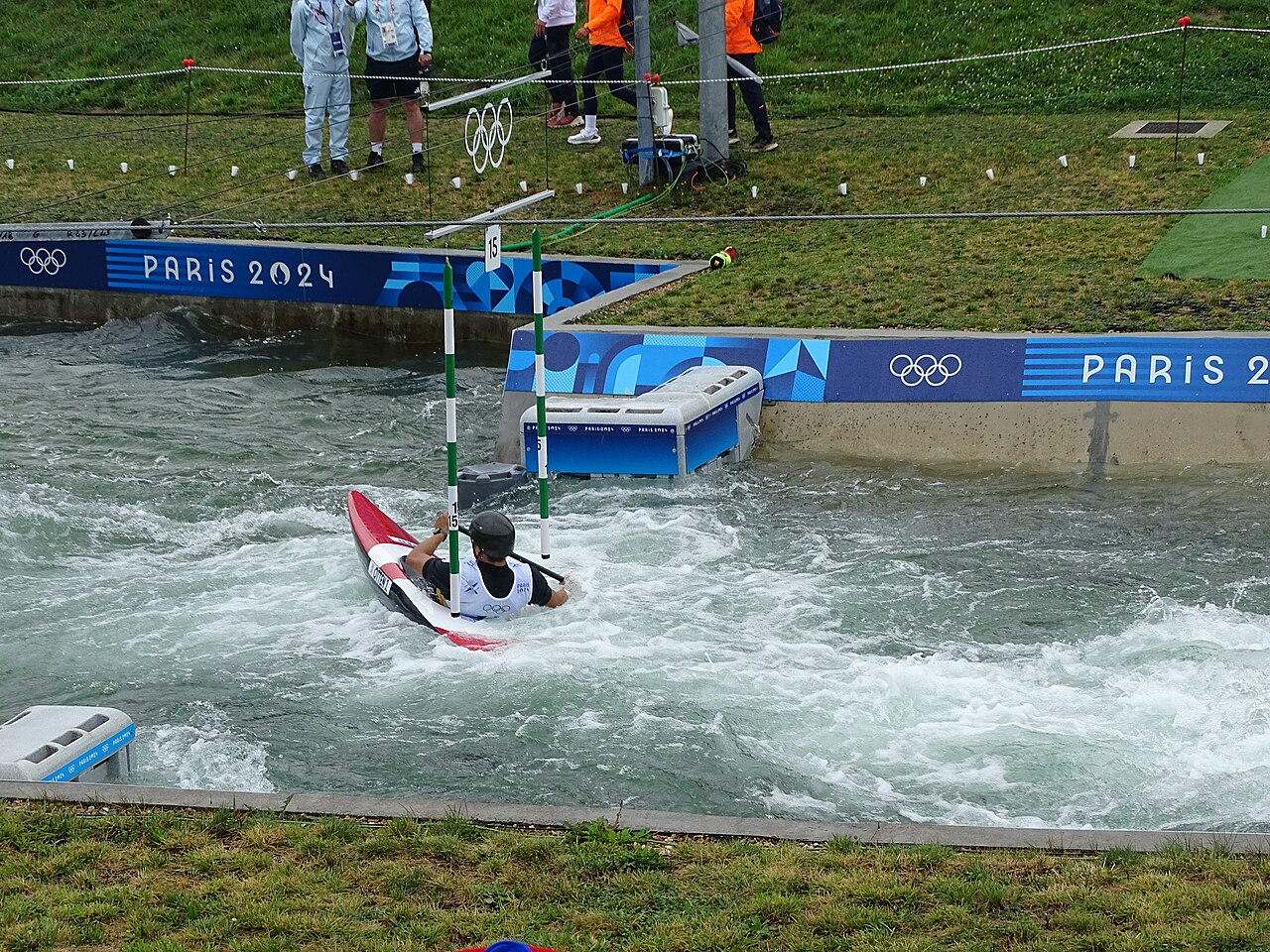
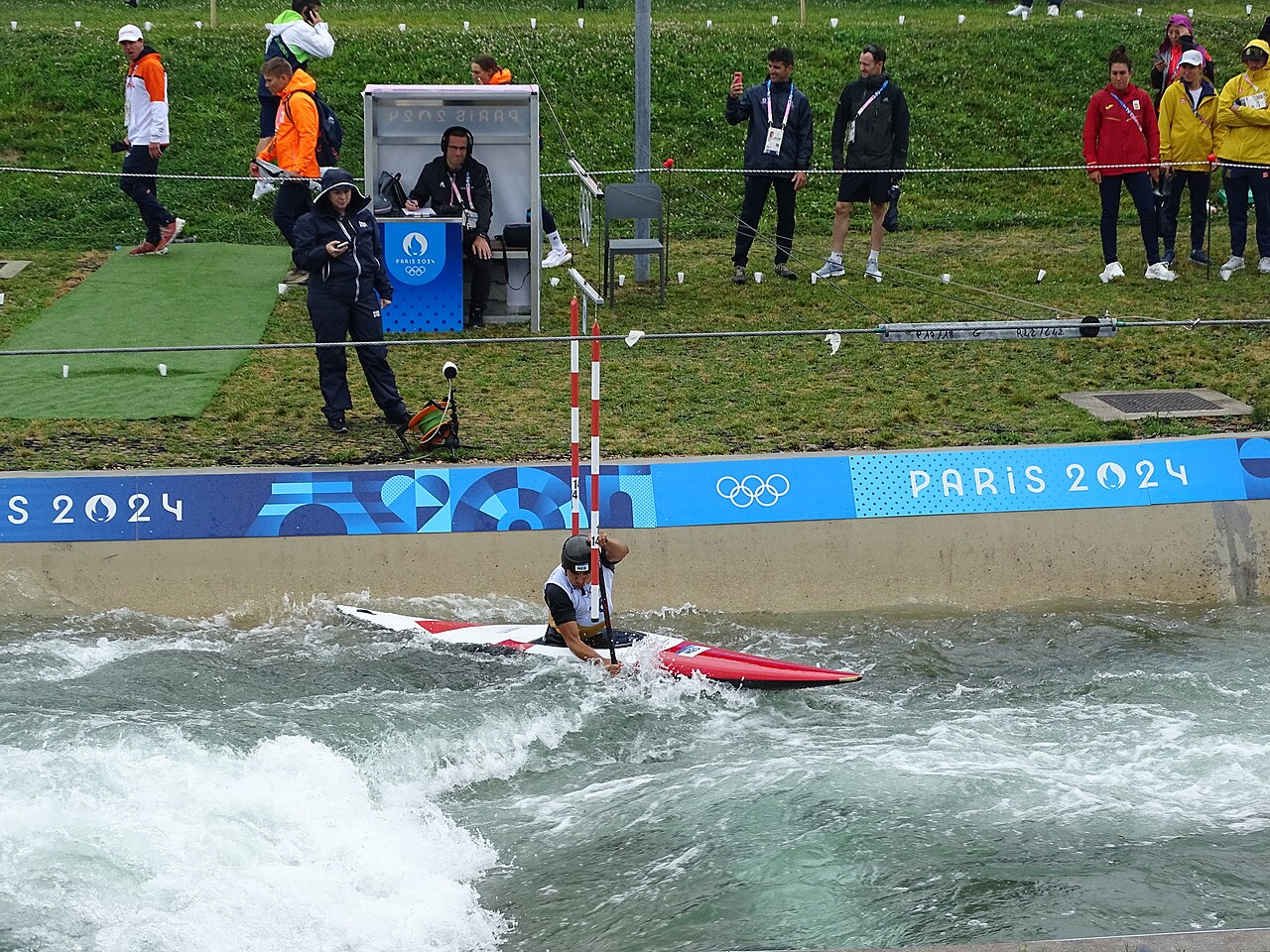
Canoeing first appeared as a demonstration sport at the 1924 Paris Olympics before becoming a full medal event at the 1936 Berlin Games. Today, Olympic canoeing is divided into two disciplines: slalom and sprint. Competitors use either canoes or kayaks, with events designated by boat type and crew size—for instance, "C-1" refers to a single canoe, while "K-2" is a double kayak. Kayak cross is a separate event within the slalom discipline, introduced in 2024. Standard race distances are 500 meters and 1,000 meters, though 10,000-meter races were held for men only from 1936 to 1956. In August 2009, the International Canoe Federation announced that men's 500-meter events would be replaced at the 2012 Olympics by 200-meter events, including a women's K-1 200 meters and a men's K-1 200 meters and a men's C-1 200 meters; this was confirmed at the federation’s board meeting in Windsor, England, on December 5, 2009. (The men's C-2 200 meters was added later.) Kayak cross was added to the program for the 2024 Summer Olympics.
- Race distances
- 500 m, 1000 m; 10,000 m for men only (1936–1956); 200 m introduced in 2012 (men's K-1 200 m and C-1 200 m added then; men's C-2 200 m added later)
- Latest addition
- Kayak cross introduced in 2024
Lore & Background
Canoeing first appeared as a demonstration sport at the 1924 Games in Paris before becoming a full medal sport at the 1936 Berlin Olympics. The sport uses two styles of boats: canoes (with 1 or 2 paddlers) and kayaks (with 1, 2, or 4 paddlers), leading to event designations such as C-1 for canoe singles and K-2 for kayak doubles. Races are typically 500 metres or 1000 metres long, though 10,000-metre races were held from 1936 to 1956.
Reader's Guide
Canoeing at the Summer Olympics has evolved significantly since its introduction. On 13 August 2009, the International Canoe Federation announced that men's 500 m events would be replaced at the 2012 Summer Olympics by 200 m events, including K-1 200 m for women and C-1, K-1, and K-2 for men. This change was confirmed at the ICF Board of Directors meeting on 5 December 2009 in Windsor, Berkshire, Great Britain. Kayak cross (KX-1) was introduced at the 2024 Summer Olympics. The medal tables for canoe sprint and canoe slalom are updated after each Games, with the overall medal table including both sprint and marathon medals. Notable notes include the ban of Russian and Belarusian athletes from the 2024 Olympics due to Russia's 2022 invasion of Ukraine, and the Russian doping scandal preventing the Russian Federation from sending athletes to the 2020 Olympics, where athletes competed under the ROC designation.
Did You Know?
- Canoeing was a demonstration sport at the 1924 Paris Olympics before becoming a medal sport in 1936.
- 10,000-metre races were held for men only from 1936 to 1956.
- 200 m events replaced men's 500 m events at the 2012 Summer Olympics, with men's K-1 200 m and C-1 200 m added; men's C-2 200 m was introduced later.
- Kayak cross was introduced at the 2024 Summer Olympics as a separate event within the slalom discipline.
The Unprecedented Dual-Award Bidding
When the IOC opened the 2024 candidacy in September 2015, five cities entered the race: Budapest, Hamburg, Los Angeles, Paris, and Rome. The field quickly narrowed as Budapest, Hamburg, and Rome all pulled out, leaving just two contenders. Rather than force a head-to-head vote, the IOC executive board convened in Lausanne in June 2017 and proposed a remarkable solution: award both the 2024 and 2028 Games simultaneously. An Extraordinary Session in July 2017 approved the plan. Paris, whose 2024 hosting would coincide with the centennial of its 1924 Games, was naturally positioned for the nearer slot. On July 31, 2017, Los Angeles was named the sole 2028 candidate, backed by an additional $1.8 billion in IOC funding. The 131st IOC Session in Lima, Peru, on September 13, 2017, confirmed the award by unanimous vote. IOC president Thomas Bach singled out the LA bid's reliance on existing and temporary venues and its entirely private funding model as record-setting achievements.
A Historic Third Hosting and a New IOC Era
Los Angeles 2028 will represent the fifth Summer Olympics and the ninth Olympic Games of any kind staged on American soil. The city had previously welcomed the Summer Games in 1932 and 1984, and with 2028 it joins an exclusive club: only London (1908, 1948, 2012) and Paris (1900, 1924, 2024) had hosted the Summer Olympics three times before. What makes LA's achievement particularly notable is that it becomes the first non-European city to reach that milestone. The 2028 edition also carries a governance first: it will be the inaugural Summer Olympics presided over by IOC president Kirsty Coventry. The event footprint extends beyond a single city, with competitions spread across the Greater Los Angeles area and two additional subsites located in Oklahoma City. The Games are scheduled for July 14 through 30, 2028, and will be officially designated the Games of the XXXIV Olympiad.
From Car-Free Dreams to Transit-First Reality
When former Mayor Eric Garcetti launched the Twenty-eight by '28 initiative, the ambition was sweeping: complete 28 infrastructure projects before the 2028 Games and make the event essentially car-free to cut congestion and ease security logistics around venues. Funding was to come from countywide sales taxes under Measure R and Measure M, and most projects were already in planning. Mayor Karen Bass later added strategies like encouraging remote work during the Games to lighten demand on transit networks. Reality proved messier. By March 2024 the original list had been substantially trimmed, with eleven projects—including five rail-line expansions—swapped for smaller, more achievable ones, some already finished. By late 2024, observers flagged that only 5.2 percent of LA Metro's $3.3 billion Olympic-related project list had secured funding, and several initiatives were running behind schedule. Staffing gaps at government agencies, coordination problems between agencies, and a late-finalized venue list compounded the difficulties. Civic leaders ultimately abandoned the car-free vision in favor of a more pragmatic transit-first approach.
A Shifting Olympic Program
The 2028 Games will showcase a notably evolved sports program. Three disciplines that debuted as optional events in 2020—skateboarding, sport climbing, and surfing—have now been elevated to the core event program, signaling the IOC's commitment to their permanence. At the same time, LA 2028 will introduce flag football and squash as new optional sports. The program also welcomes back several long-absent or historically significant events: baseball and softball return to the Olympic lineup, cricket makes its first appearance since 1900, and lacrosse re-enters as a medal event for the first time since 1908. This blend of new additions, returning sports, and promoted disciplines reflects a broader IOC strategy to keep the Games culturally relevant while honoring historical traditions. The result is a 2028 program that stretches from board sports to bat-and-ball games, offering a wider range of athletic expression than any previous Summer Olympics.
Gallery

Frequently Asked Questions
When did canoeing first appear at the Olympics?
Canoeing debuted as a demonstration event at the 1924 Paris Games and earned full medal status starting with the 1936 Berlin Olympics.
What are the two main disciplines in Olympic canoeing?
The sport is split into sprint (flatwater racing) and slalom (navigating a course of gates on whitewater). Both disciplines have been part of the Olympic program since 1936.
What do designations like C-1, K-2, and K-4 mean?
The letter indicates the boat type—C for canoe (paddled with a single-blade paddle) and K for kayak (paddled with a double-blade paddle)—while the number tells you how many athletes are in the boat. For example, K-4 is a four-person kayak.
What distances are raced in Olympic canoe sprint?
Standard sprint events cover 500 meters and 1,000 meters, with a shorter 200-meter distance added at the 2012 London Games. A 10-kilometer marathon race was also contested between 1936 and 1956.
What is kayak cross (KX-1) and when did it join the Olympics?
Kayak cross is a head-to-head elimination race on a slalom-style course, and it made its Olympic debut at the 2024 Paris Games. It is the most recently added event to the Olympic canoeing program.
More in Canoeing at the Summer Olympics 1-23
Spotted an error? Know more?
This is a living reference — every entry is fact-audited, and reader corrections feed straight into our audit queue. Suggest an edit · See this site's audit record